

Category: Energy Savings

Make Everyone Happy With Energy Saving Measures

As you begin watching the leaves turn from the green of summer time to autumn colors of red, gold and brown, it is natural to anticipate the cold of winter lurking around the corner. Most people are enamored by the bright colors of fall, but there is something sinister about them, as well. It doesn’t have to be this way, at least, not if you have done your due diligence and taken care to prepare your home. Home heating service and repair are necessary components of living a comfortable life. It calls for professional HVAC service in order to keep the cold at bay. No one wants to spend the winter months wondering whether they will be able to get through without a heating system emergency and a breakdown would be even worse. Heater maintenance before going into the winter season is a time honored responsibility of home owners everywhere. Unless you want to look forward to new heater installation sooner rather than later, it is a good idea to call the professional HVAC service contractor of your choice to take care of this responsibility for you. Otherwise, you can expect to spend a lot of time mulling over why
Read More »

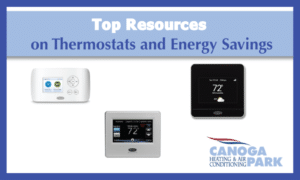
Top Resources on Thermostats and Energy Savings

The thermostat is one home device that many homeowners take for granted or at least tend to forget from time to time. However, the thermostat plays a vital role in not only keeping your home environment comfortable but also helping you save energy throughout the year. If you’re curious about how you can better utilize your thermostat to maximize energy savings, take a look at the resources below. Top Resources on Thermostats and Energy Savings If you’re ready to learn more about thermostats and how they help you save energy, then you’ve come to the right place. Here are some helpful resources that will help you better understand how smart and programmable thermostats work and how they help you save more energy each month: Thermostats from Energy.Gov This article on thermostats from the U.S. Department of Energy is a great place to start if you want to learn more about thermostats and how they contribute to energy savings. The article covers general thermostat operation, limitations for certain types of heating, and more information about choosing a programmable thermostat. If you are considering buying a new thermostat, this is a must-read. What Can a Smart Thermostat Do that Mine Can’t Do? In this article

Read More »

When Will the HVAC Efficiency Standards Be Raised?

Many people know that it is important for the U.S. to adopt some measures to help reduce the amount of energy consumed each year. In order to address this problem, back in 2009, the Department of Energy worked with experts in both the utilities and HVAC industries to come up with an effective way of increasing HVAC efficiency standards. The goal was to implement higher standards that would raise annual fuel utilization efficiency (AFUE) ratings from an AFUE of 78 to a new minimum of 90. This increase in HVAC efficiency could make a major impact in reducing energy consumption. The problem, however, was that these new minimum AFUE requirements would inflict a heavy financial burden on many homeowners. In order to comply with the minimum 90 AFUE HVAC efficiency standard, homeowners would need to install a condensing furnace as this is currently the only type of combustible heating unit capable of meeting the required minimum standard. Unfortunately, installing a condensing furnace is not as easy as one might think. This type of furnace has its own unique requirements and would mean homeowners would need extensive retrofitting in order to modify their homes for this type of heating system. Not

Read More »

Tips for Putting Together Your Summer Energy Savings Plan

The invention of air conditioning made life immensely more comfortable for all of us. It is very pleasant to be able to come home to a cool house on a hot summer day. We pay for that comfort, however, in the form of higher energy consumption and increased utility bills. A house’s A/C unit utilizes 15 to 25 percent of the total energy the house uses monthly. To begin to put together a homeowner’s Summer Energy Savings plan, the first item to address is efficient use of your air conditioning system. Most people can be comfortable with a thermostat setting of 78°F to 80°F, so set your temperature up some. You will save seven to ten percent on cooling costs for each degree you set it above 78°F. If you have ceiling fans, run them along with your A/C and your will feel four to five degrees cooler. Just be sure to turn the fan off when you leave the room, as the fan cools you and not the room. Set the thermostat up several degrees when you will be away from home for several hours. Better yet, invest in and install a programmable thermostat. Close air vents in rooms

Read More »

How Is Heating And Cooling Equipment Efficiency Measured?

A lot of people are becoming aware of the need to reduce their carbon footprint and help in efforts to combat global warming. Accordingly, it is important to make sure that your AC system is as efficient as possible. An efficient HVAC system does not only operate better but also saves energy. So, how is heating and cooling equipment efficiency measured? Here are a few ways that you can explore: EER The Energy Efficiency Ratio is designed to give you a rough estimate of how much cooling you will get on your HVAC system for every dollar you spend on energy. The rating is often based on the season’s hottest day other than an average of the entire season. EER is calculated by dividing the total output cooling energy with the incoming electrical energy. The Energy Star The Energy star is provided by the US Environment protection agency and is only awarded to an HVAC system that meets or surpasses the high energy efficiency guidelines. The guidelines are often based on how much the HVAC system contributes to the nationwide efforts to save energy, the difference in cost between the system, and its less efficient counterpart and the performance of

Read More »

Myth Busters: 3 Ideas About Energy Efficiency Debunked!

There are many energy efficiency myths that people believe to be true. Unfortunately, these misguided beliefs are costing the average consumer a lot of money in high utility bills. Below are some simple truths about energy efficiency to bust the myths. Myth 1: More Energy is Consumed When Lights are Switched on and off Several Times than when They are Left on The truth is that energy is used to power light bulbs to produce light, so they do not consume anything when they are switched off. Turning the lights back on simply completes the circuit needed to turn on the light. As far as incandescent, LED and other types of modern light bulbs are concerned, the statement is simply a myth. However, fluorescent lighting tubes usually take a couple of minutes to turn on, so they may consume more energy to turn back on. Therefore, it may make sense to leave them on throughout. Myth 2: An Electric Space Heater can Help Save you Money In some countries, this can be true because other heating fuels like natural gas, propane gas and heating oil are much more expensive compared to electricity costs. In the United States, however, natural gas

Read More »

Energy Saving Technologies for Your Business

MightyServ appreciates the fact that heating, ventilation and air conditioning accounts for over 50 percent of your energy bill. In a bid to help businesses to minimize their energy consumption and increase their energy savings, we can implement any of the following energy saving technologies: Thermal Energy Storage In commercial establishments, the electricity tariff is designed in such a way that the cost per unit during peak hours (normal working hours) is much higher than off-peak rates. We can help you implement a thermal energy storage technology that makes use of affordable electricity at night and stores the cooling energy for use during peak hours, when the unit cost of electricity is highest. This is done by freezing water at night. During normal working hours, the chilled water or ice is used to cool the business premise. The energy savings attributed to thermal energy storage can be quite significant, so every business owner needs to consider implementing the technology. Adjustable Speed Drives (ASD) Speed drives are sophisticated electronic devices designed to control the speed of motors based on user settings, programmed instructions or demand. When your HVAC needs are minimal, the ASD can reduce the speed of blower and fan

Read More »

Why Is SEER Used for Rating Heating and Cooling Devices?

People using any type of cooling device should know what is SEER. Seasonal Energy Efficiency Ratio or SEER is used to rate cooling appliances. The rating is based on energy efficiency performance of systems like HVAC, air conditioners and heat pumps. The rating is calculated taking into account an appliance’s cooling output for a given unit of energy that it consumes. Higher rating is given to systems that output more cooling while consuming less energy. The benefit of using such devices is that it results in lower electricity bill. Such a device is eco-friendly because it releases less green house gases. Rebates are available to users who use systems with high energy efficiency. Devices that have higher SEER ratings provide greater efficiency. Federal government has made it mandatory for central air-conditioning equipment manufacturers to sell only those units that have minimum SEER-13 rating. Buyers should know that air-conditioning equipments with SEER rating of 18 or even 23 are available. An air-conditioning system having a minimum of SEER-16 rating should be installed to realize the advantages of using energy efficient system. Users who want to calculate their savings can easily do so by using Cooling Calculator. The calculator can be used

Read More »

Home Energy Efficiency Tips to Help You Save Money

Chances are, if you want to save money, you are doing everything you know how to do. Do you know how to save money on your electric bill? In the paragraphs below, we are going to give you some energy efficiency ideas that can go a long way.Here’s our home energy efficiency tips … Check the Energy-Efficiency Ratio Before You Buy an Air Conditioning Unit Before you go out and by an air conditioning unit, check to see what its energy-efficiency ratio is. You can find out the energy efficiency ratio by taking the unit’s cooling capacity and dividing it by the energy requirement. If it comes out with an EER of 10 or more, that is great, while 6 or 7 is fair.Go for the Smallest Air Unit Possible So many people are under the impression that bigger is better. Don’t go out and buy the biggest system out there — go for the smallest one that will meet your needs. Energy Efficiency Tip for Doing Laundry When doing laundry, wash full loads. By doing this, you will be using the machine less and saving energy. Energy Saving Tip for Your Refrigerator When it comes to saving money on

Read More »

Study Examines Benefits of the Use of Geothermal Energy in Non-Commercial Buildings

The evolving geothermal heating and cooling technologies could be the wave of the future in cutting the cost of operating commercial and other non-residential buildings once businesses can get past the initial cost, according to a study by Frost & Sullivan, a market research and analysis firm in San Antonio, TX. The market already is expanding. It received revenue of $120.8 million in 2012, and the Geothermal Market is expected to reach $147.6 Million by 2017, thanks in part to laws in Canada and the U.S. promoting geothermal and other renewable energy sources. Laws already on the books include the Energy Independence and Security Act of 2007 and the earlier Energy Policy Act of 2005. The study looked at the period between 2009 and 2017 and identifies geothermal heat pumps, both open and closed loop designs, as primary segments of the geothermal market on the North American continent. The Higher Energy Efficiency of Geothermal Heating and Cooling has long been apparent. The ground at about 10 feet deep is warmer in the winter and cooler in the summer than the air above it, with a constant temperature of between 50 and 60 degrees Fahrenheit. Geothermal heat pumps take advantage of

Read More »
Archives